Harmonise your multi-ERP accounting data with Sixthfin’s software platform
Different ERPs, different charts of accounts, different currencies, different languages: every subsidiary speaks its own accounting language. Comparing performance, spotting discrepancies or rolling out the same controls everywhere becomes a slow, manual exercise. Sixthfin’s platform harmonises your accounting and financial data into a single, comparable data layer, giving your Finance, Control and Audit teams one shared view across the whole group, without a heavy IT project.
Make your multi-ERP accounting data comparable
50% of finance leaders are not fully confident in their own numbers once the books are closed. The reason is almost always the same: data still scattered across systems, subsidiaries and formats that spreadsheets alone can no longer hold together.
Sixthfin’s software gives every entity a common accounting language, while taking into account what makes each one different.
-
1 Harmonise every piece of data, whatever its source
-
2 Build a common language, without disrupting your IT systems
-
3 Put a single data layer to work everywhere
Harmonise your accounting data, whatever its source or volume
Every new IT development, acquisition, subsidiary or regulatory change adds another system, format, structure or language. Unify your data before this complexity becomes a breaking point:
- Bring all your data together, across every ERP, chart of accounts, currency and language, with no limit on volume
- Translate every data source into a single, group-wide chart of accounts, without replacing or reconfiguring your existing systems
- Keep your existing systems in place: data is extracted without any direct connection to your ERPs, and with no replacement or reconfiguration
- Onboard a new entity, an acquisition or a new subsidiary, quickly, by mapping its data onto this shared framework
- Rely on a platform that is international by design: multilingual, and already deployed in more than 70 countries

Build a common, traceable and shared language
Harmonising your data does not mean losing detail: every data point mapped into the shared framework stays linked back to the accounting entry it came from, directly within the Sixthfin platform:
- Keep full traceability between every harmonised data point and the accounting entry behind it, with drill-down right down to the finest level of detail
- Give your Finance, Control and Audit teams one shared view of the data on a single platform, wherever they are based
- Remove the language barrier with AI-powered translation of accounting information and communication between teams
- Document the structure of your shared chart of accounts, to ensure its longevity as your group evolves

Put a single data layer to work across every use case
Harmonise once, use everywhere. Your data is ready for review and analysis straight away. It powers every Sixthfin solution and can also feed your own AI projects.
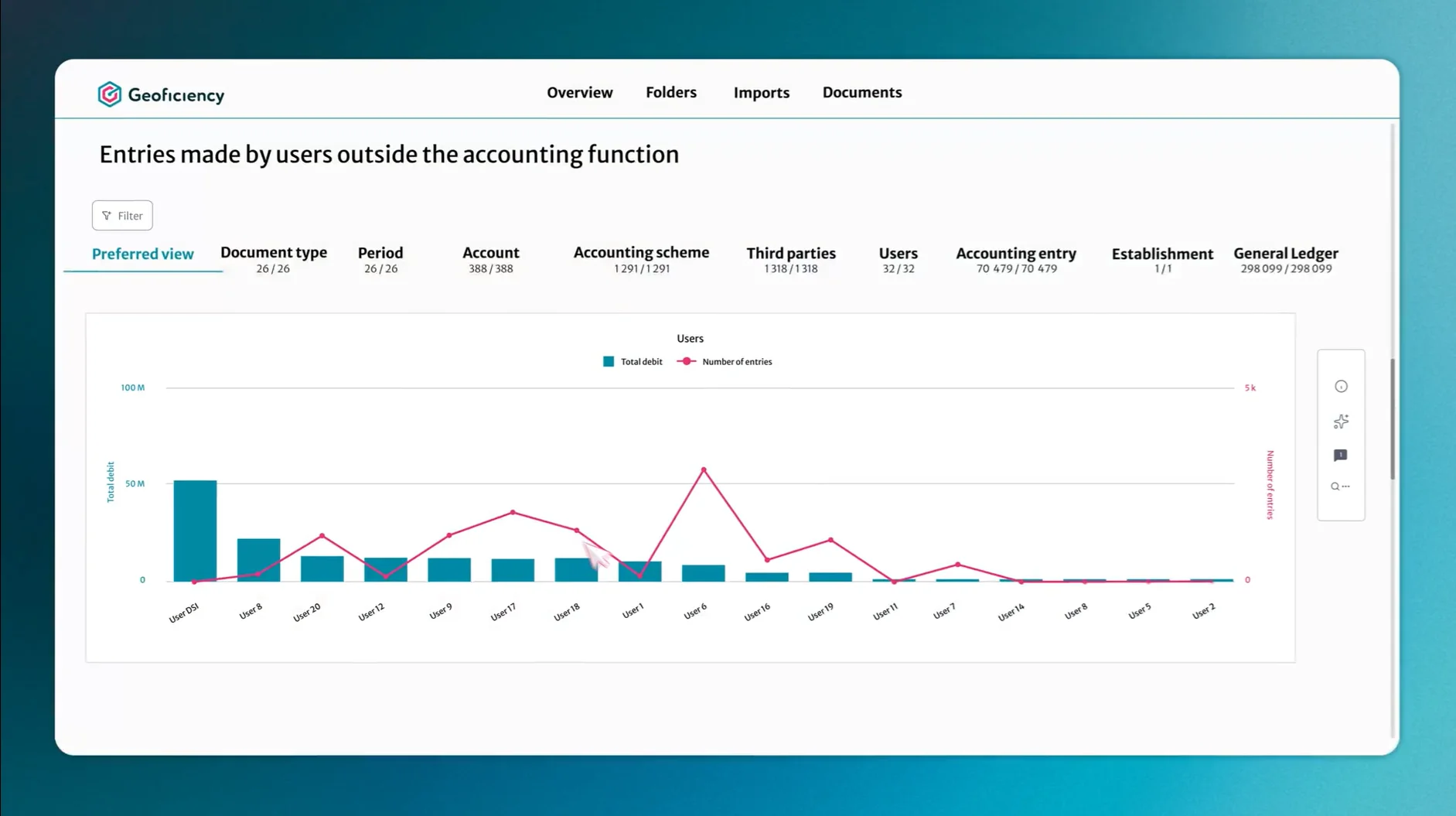
- Accounting entries with Geoficiency: detect fraud, error and compliance risk across all your journal entries, using data that is already harmonised across all your entities
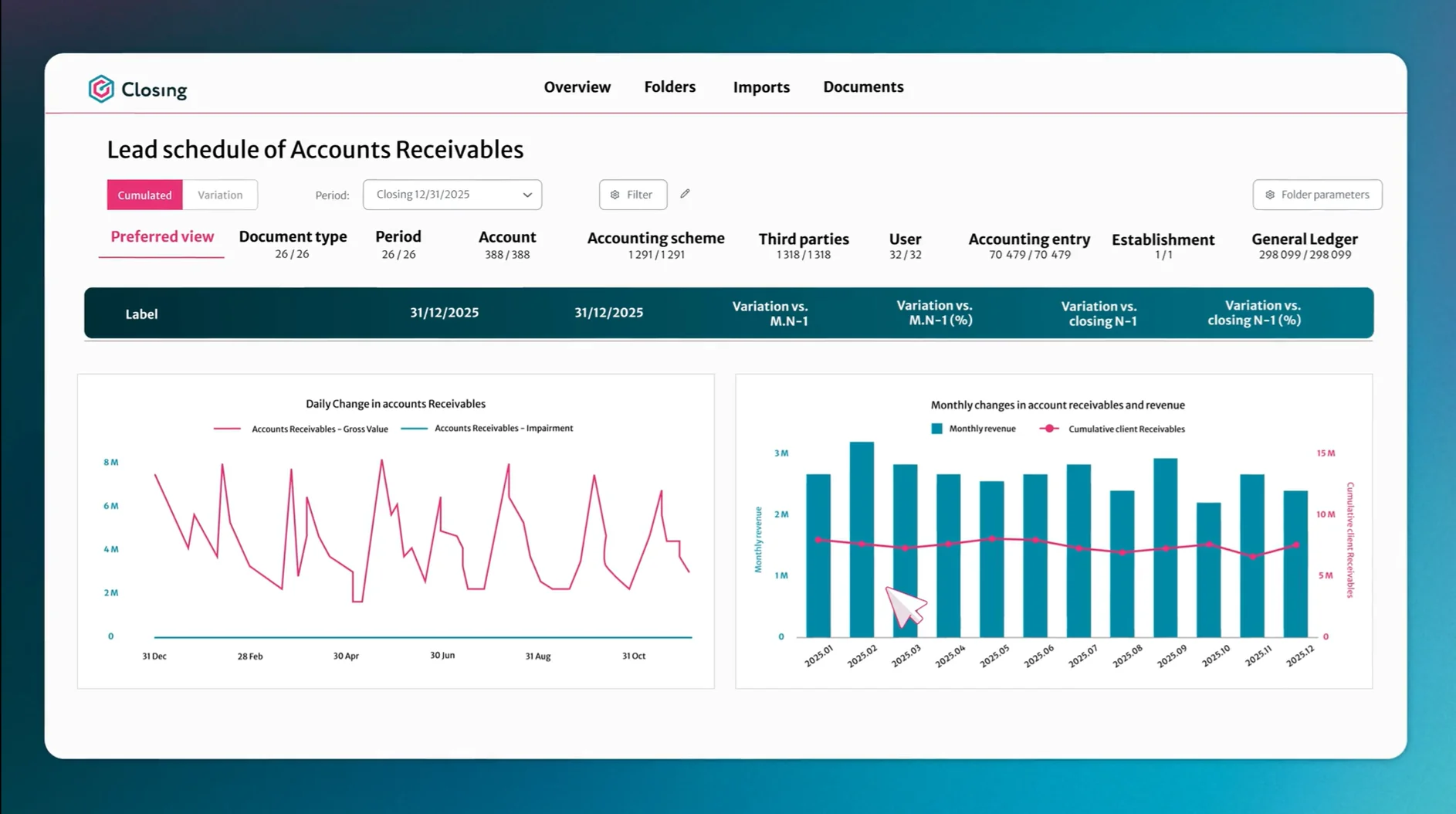
- Close controls with Closing: strengthen and accelerate your account review and close (account justification, analytical review, documentation) on a consistent data set across every subsidiary.
- Expense claim controls with T&E Controls: spot anomalies, behavioural red flags and control failures in your expense claims, comparing consistent data whatever the entity of origin.
- AI initiatives: give your models and agents structured, documented, comparable data, prerequisites for relevant results


We were looking for a way to manage our many ERPs, sources and data sets, which made it difficult to automate controls and share best practice across the group

Designed for Seamless Integration.
A clear, intuitive platform custom-made for your organisation, stakeholders, and priorities.
Your Frequently Asked Questions about
accounting and financial data harmonisation
1. Why harmonise accounting and financial data into a single framework?
Without a shared framework, every subsidiary produces data in its own format (ERP, chart of accounts, currency, language), which makes comparing and analysing it slow and unreliable. In most groups, most of the time teams spend on control work goes on collecting, reworking, reconciling and formatting data, at the expense of analysis. A single, group-wide framework removes that work at the source. Once it is set up, it does not need to be redone. Harmonised data becomes immediately usable across all your accounting, finance, control and performance management work, freeing your teams to focus on what creates value: analysis.
2. How does Sixthfin harmonise accounting data?
Your data is first extracted from your source systems, then loaded into the Sixthfin framework. This framework rests on two pillars:
- A chart of accounts mapping: each local chart of accounts is mapped onto a single, group-wide chart of accounts, whatever the ERP, currency or original language.
- Contextual information specific to each entity: users, journals, public holidays, close calendar, and more.
This context means controls run according to each entity’s own specifics. An entry posted on a local public holiday, in a specific journal, or by an authorised user is correctly interpreted for that entity. Results stay comparable across subsidiaries, while still each entity’s own specifics
3. Do we need to replace or reconfigure our existing ERPs to harmonise our data?
No. Your data is sent to the Sixthfin platform through secure data feeds via API or SFTP, with no direct application connection to your ERPs. Your ERPs keep running as normal. It is the use of the data, once transmitted, that becomes common across the group.
4. What data does harmonisation cover?
Harmonisation covers general ledger data, along with the related supplier and customer master data. Depending on which Sixthfin solutions you use, this scope can extend to expense claim data. In every case, it is transaction-level data, not data that has already been aggregated, that gets harmonised. This lets you compare, consolidate and analyse your data through a single lens, and trace it all the way back to the original entry and the reference of its supporting document.