Accounting Oversight Software to Centralise Your Financial Management
In a complex environment where financial data originates from multiple sources and contexts, leaders must rely on unified and accurate management to make better strategic decisions.
Unify and Strengthen Financial Management to Transition from Data to Decisions
-
1 Centralise and secure your accounting and financial information
-
2 Strengthen strategic decision-making
Centralise and Secure Your Accounting and Financial Information
Standardise, centralise, interpret. The consistency and precision of financial management depends on the quality and interpretability of financial data:
- Overcome constraints arising from diverse sources and contexts: centralise and standardise all your data (across different ERP systems, accounting frameworks, languages, and currencies) to create a unified framework
- Utilise consistent risk indicators across your entire scope and standardise control workflows
- Collaborate effortlessly with all stakeholders in the accounting and financial value chain within one unified platform

Strengthen Strategic Decision-Making
Direct your performance where it creates the most value. Reassure your leaders and stakeholders about the robustness of your accounting and financial information system through:
- Objective analyses of the efficiency of your accounting processes and the reliability of your financial information
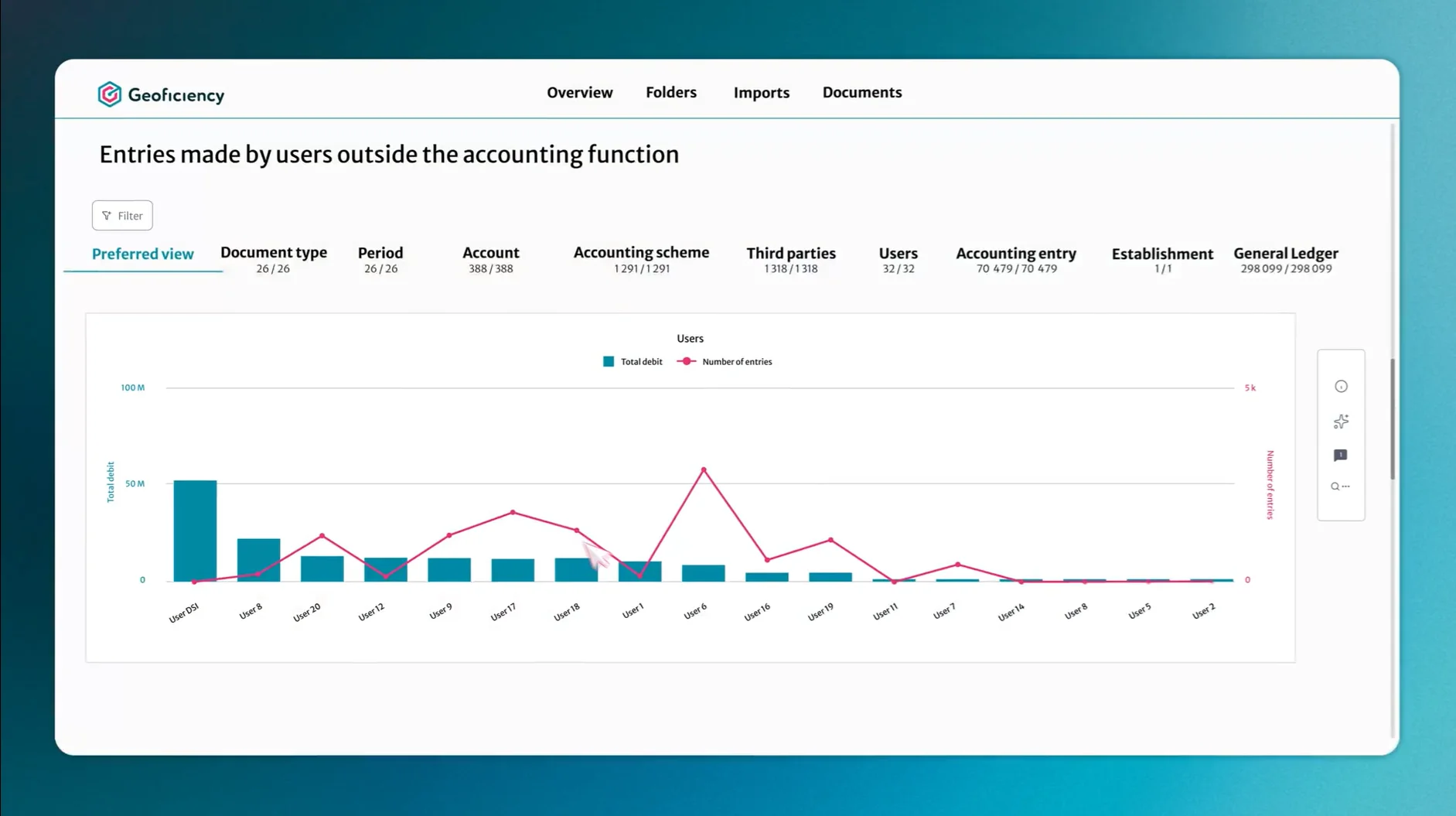
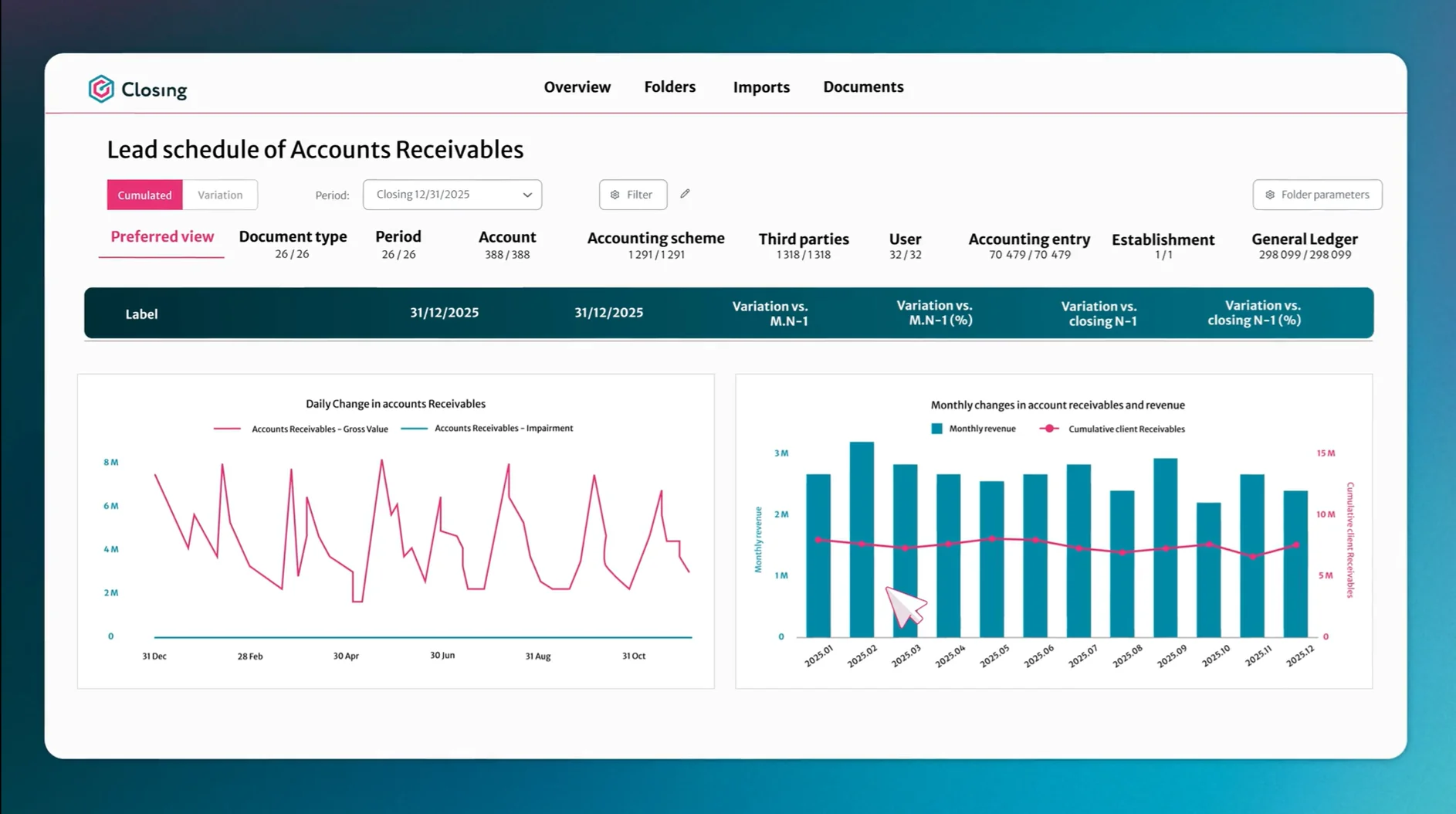
- Intuitive dashboards that cover your entire scope, along with key performance indicators
- A comprehensive and customisable library of controls
- The detection of weak signals and atypicals through AI-powered enhanced controls

Take action:
explore our solutions
Closing: the solution for streamlining and accelerating your reviews and closing processes
Geoficiency: the solution for risk detection, compliance, and operational efficiency
Your Frequently Asked Questions About
Accounting Oversight
1. How to ensure smaller subsidiaries comply with the French Sapin 2 anti-corruption requirements?
Not all entities within a group have the same level of exposure. Applying the same control intensity everywhere is counterproductive and drains resources a proportionate approach should be recommended: enhanced and frequent reviews for high-risk subsidiaries (sensitive geographical areas, activities exposed to the public sector, high-risk activities, physical subsidiaries, etc.), and lighter or rotating reviews for low-criticality entities. The goal is a consistent group-wide framework that adapts to local risks without overwhelming smaller teams.
2. How to ensure that key accounting controls are implemented consistently across all entities?
In a multi-entity group, there is a strong temptation to let each subsidiary adapt controls to its local context: different ERP systems, specific charts of accounts, teams with varying levels of resources. The result is a system that appears comprehensive, but whose actual implementation is impossible to verify from the group’s head office. Ensuring consistency requires defining a set of non-negotiable controls that are common to all entities, with standardised implementation and documentation procedures, as well as centralised progress monitoring that does not depend on reports from local teams.
3. How can group visibility be enhanced, particularly in small subsidiaries?
Small entities are a paradox: they have fewer resources for control, but their risk isn’t necessarily smaller. A drift towards manual entries, circumvention of approval procedures or delays in providing justification may go unnoticed for several cycles due to a lack of supervision. Enhancing group visibility does not necessarily require more on-site audits, but rather risk indicators that are monitored continuously and consistently across the entire scope, capable of flagging local anomalies before they escalate.
4. How to get a real-time view of the closing review progress and bottlenecks?
Without a centralised dashboard, the progress of account review and justification activities is managed through email reminders and follow-up meetings, which generates a significant coordination burden and masks bottlenecks until they become critical. A consolidated view by entity and by task, in real time, allows you to anticipate delays and arbitrate priorities before the schedule is compromised.