Geoficiency: a solution for detecting and mitigating accounting risks
Our comprehensive software for accounting control makes your analysis compliant and robust. Investigate without limits: on a trusted and exhaustive foundation. Geoficiency will make your controls sharper, and your analyses more strategic.
Prepare better. Transform faster.
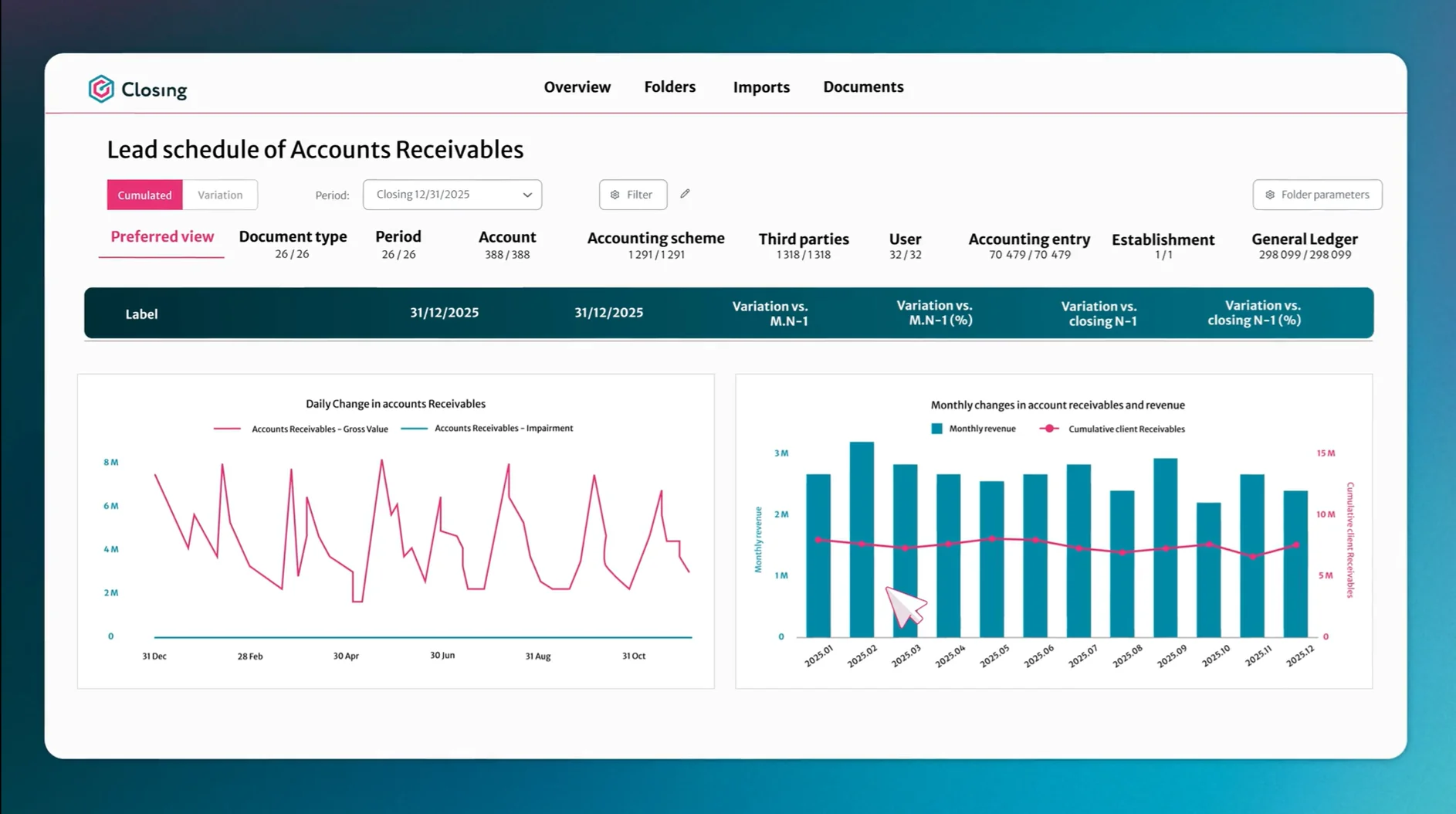
Analyze your accounting data to identify risks, anomalies, and errors
Achieve smoother processes and sharper decision-making.
Geoficiency puts cutting-edge technology at the service of financial management, control, and audit departments.
-
Fraud and error risk detection

-
Continuous improvement and process efficiency
-
Simplified compliance
-
Effective coordination and collaboration
-
Secured and optimised financial flows
-
Strategic transformation and leadership



Fraud and Error Risk Detection
Take control of your accounting streams’ quality. Build reliable and exhaustive performance indicators:
- Harmonise, secure, and fully leverage your accounting data irrespective of ERP systems, chart of accounts, currencies, or languages
- Use a library of modular, AI-enhanced controls, either native or customised
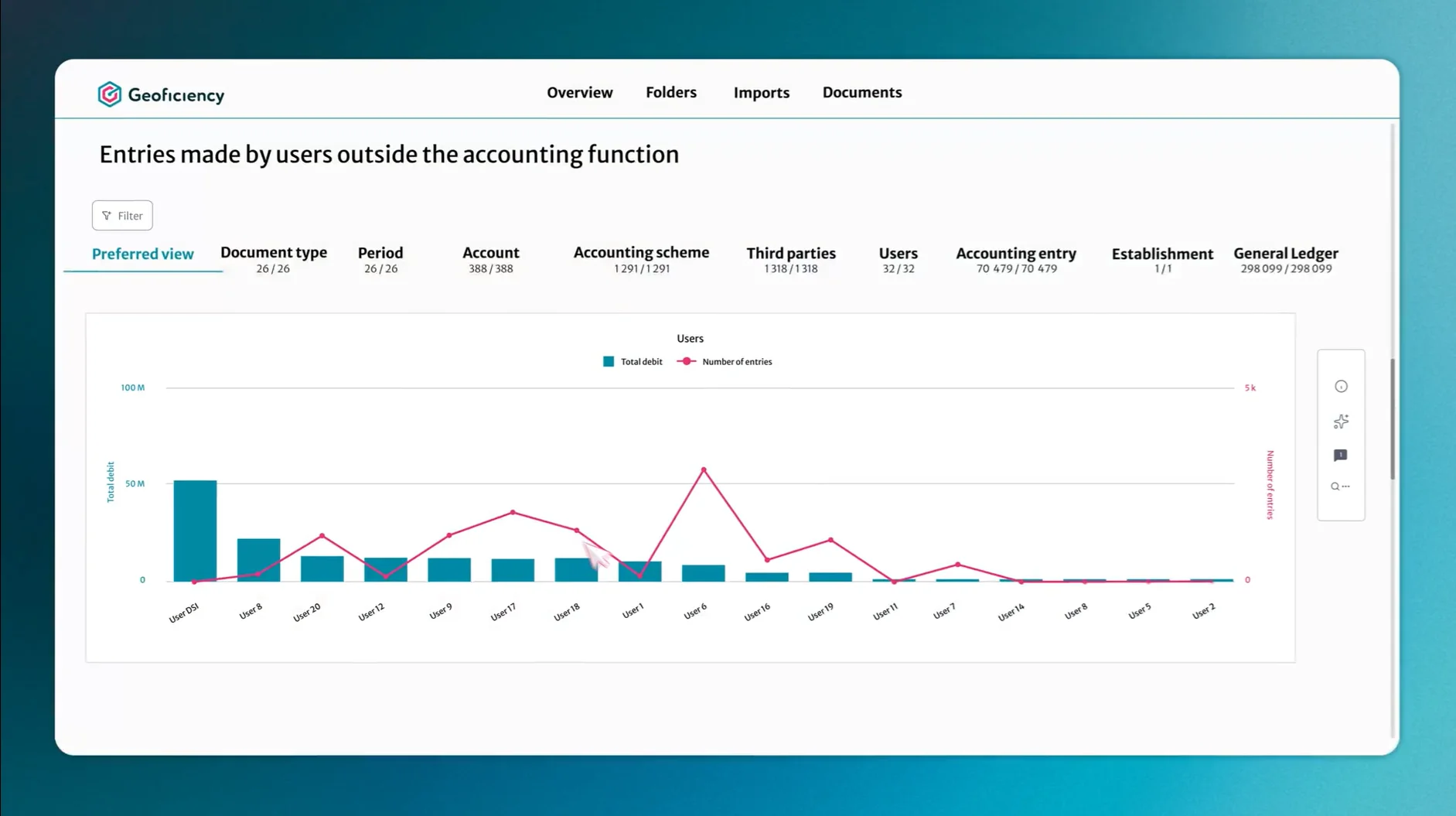
- Analyse automated alerts and flag atypical entries through transaction profiling
- Automatically detect risk hotspots across transactions, entries, and entities, focusing efforts where it truly matters
- Monitor unified risk indicators across all your entities

Continuous Improvement and Accounting Process Efficiency
Manage your financial data with peace of mind using flawless tracking, optimal control, and ongoing improvement:
- Eliminate invisible performance losses by overseeing and enhancing process efficiency and their accounting trace
- Leverage advanced second-level control tools to better identify unusual transactions and enhance analytic relevance
- Minimise errors and reduce post-review adjustments with reliable workflows
- Benefit from dynamic, customised dashboards to monitor control campaigns effectively

Simplified Compliance
Meet international regulatory requirements efficiently (UK ECCTA failure to prevent fraud offence, UK Bribery Act, French Sapin 2…) with clear, documented, and always-compliant solutions:
- Capture detailed conclusions and control results with automated documentation and archiving
- Effortlessly integrate your risk mapping
- Deploy targeted fraud checks through automated processes
- Thanks to our platform update, remain up-to-date with ever-evolving international regulations
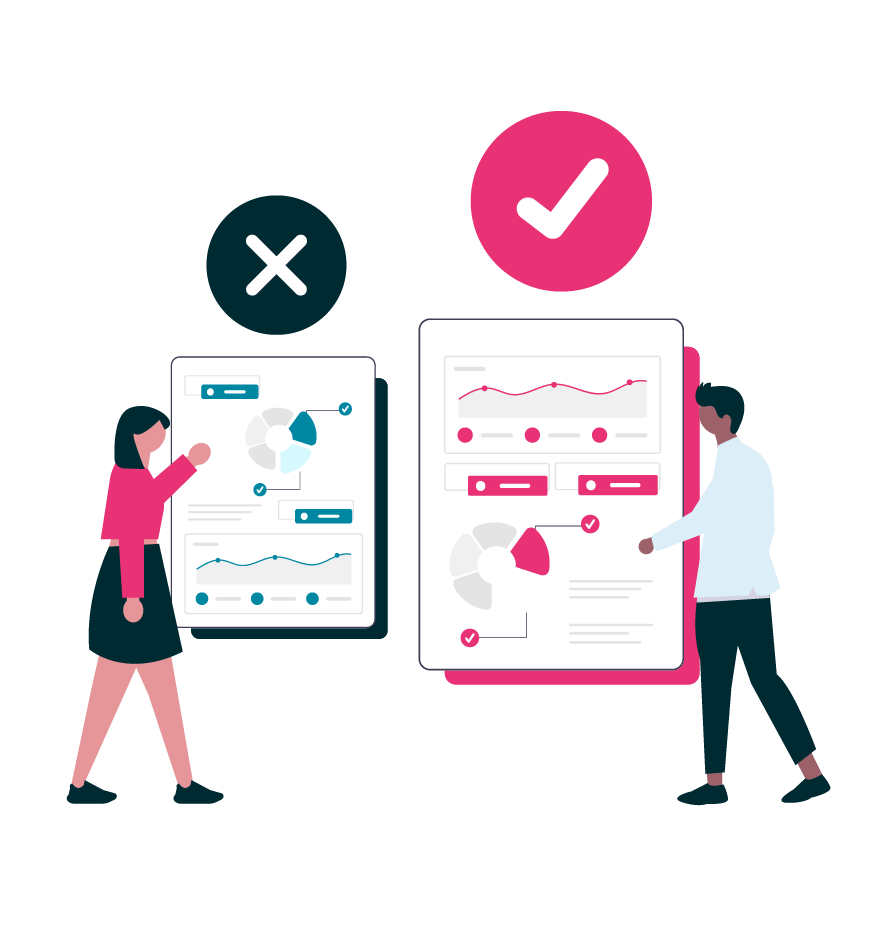
Efficient coordination and collaboration between accounting, finance, audit, and internal control
Maximise synergy within financial management, audit, and control teams through a collaborative platform:
- Collaborate seamlessly across finance, compliance, taxation, internal control, and accounting functions under a unified digital workspace. Clarity meets actionability for all stakeholders
- Automate repetitive tasks, freeing up valuable team capacity for impactful actions
- Standardise workflows and harmonise practices across all entities
- Centralise audit trails and operational documentation using integrated collaboration tools, workflows, and seamless archiving

Secure and Strengthen Financial Flows
Detect risk zones easily and secure your financial streams:
- Detect risks and trigger alerts for agile and targeted risk mitigation
- Conduct internal audits with enhanced efficiency and optimise external audit processes
- Drive due diligence for M&A processes and post-acquisition evaluations using reliable indicators, instant red-flag analysis, and actionable diagnostic tools

Strategic Transformation and Leadership
Focus finance so it delivers maximum impact and value. Move beyond operational constraints and concentrate on decisive objectives:
- Make performance visible across financial teams with bespoke and targeted reports
- Strengthen collaboration and improve teamwork throughout the whole finance department
- Boost team engagement by refocusing top talent on high-value missions

A platform for control and analysis created alongside our clients, to transform and accelerate.
Solutions designed with our users for our users

Strategic guidance supported by subject matter experts

A robust, fast, and secure platform designed to meet the pace of your challenges

Immediate adoption. Efficiency from the very first click.

A solution that adjusts to your reality, not the other way around.


We needed an agile tool that could allow us to meet our organisational needs. Given that we operate multiple ERPs deployed worldwide, use different chart of accounts, and manage multi currency accounting.


The benefits: time savings, ease of deployment, standardisation of processes and methodologies


Now, I can't envisage working without Geoficiency

Designed for Seamless Integration.
A clear, intuitive platform custom-made for your organisation, stakeholders, and priorities.
Your Frequently Asked Questions about
Accounting Control and Analysis
1. How can anomalies be quickly identified in a growing volume of accounting entries?
When transactions reach a certain volume, weak signals more easily slip under the radar. The challenge is to move from a sampling approach (which does not allow weak signals to be detected) to a comprehensive analysis of flows, with alerts calibrated to the organisation’s actual risks. Thanks to this comprehensiveness and targeting, automation produces relevance, and teams can focus on the real issues without being overwhelmed by ineffective sample analyses or false positives.
2. How to guarantee data quality, comprehensiveness and consistency across multiple ERPs and subsidiaries?
The heterogeneity of source systems is often considered the main obstacle to reliable and effective analysis: a disparate chart of accounts, different data formats, currencies and languages, multiple technical or business contacts.
The reliability of analyses therefore depends on a preliminary stage of data harmonisation and standardisation, regardless of the heterogeneity of the sources, which is therefore essential. Without this standardised “source of truth,” manual reprocessing will accumulate, and confidence in your consolidated figures will remain fragile.
3. How can accounting controls be made more objective and reliable in order to avoid comments from statutory auditors or the Board?
Audit comments rarely flag gross errors: they most often target insufficient justifications, unexplained discrepancies or controls whose actual execution cannot be proven. Objectifying controls means relying on comprehensive data rather than sampling and producing documented and traceable conclusions for each control point. It’s the shift from a system that reassures by its form to one that convinces by its substance through comprehensive data and traceable conclusions.
4. How can you prove that controls are properly performed, documented and traceable?
Traceability is often the missing link in internal control systems: controls are performed, but evidence of their execution is usually scattered across emails, local files and informal notes making audit reconstruction a nightmare. In the event of an AFA or statutory audit, a coherent audit trail is available instantly, protecting the organisation from doubts about its control effectiveness. Easily structuring documentation at the time of execution, rather than after the fact, is the only viable approach at the group level.
5. How to prevent the risk of internal fraud linked to manual journal entries?
Various manual operations remain the most common vector for accounting manipulation: lack of validation workflow, vague descriptions, unusual users, batch bypassing, unusual posting hours. These isolated signals are invisible in a traditional review but revealing when you have the ability to analyse the entire flow with profiling entry behaviour. This isn’t about suspecting your team; it’s about building a system robust enough to deter and detect any attempt at fraud automatically.