Closing: account review software to accelerate your close-cycle controls
With Closing, the close is no longer something you endure. It's something you run. The platform streamlines reviews, strengthens data integrity, and structures your processes. The result: a simpler experience, a shorter cycle, and renewed peace of mind and agility for your teams.
Accelerate and take control of your accounting close. Gain time, build confidence, and drive impact.
Eliminate manual interventions, centralise multi-ERP analysis, optimise controls and reviews. Closing removes operational bottlenecks to enhance reliability and improve performance during this crucial period.
-
Accelerate analysis and drive insights

-
Automate controls and detect anomalies
-
Harmonise processes and coordinate teams
-
Centralise documentation and ensure traceability
-
Optimise security and resilience
-
Attract and retain talents




Optimise your closing processes with faster, smarter analysis
Close faster, work smarter, and reduce manual effort with Closing’s automated analyses:
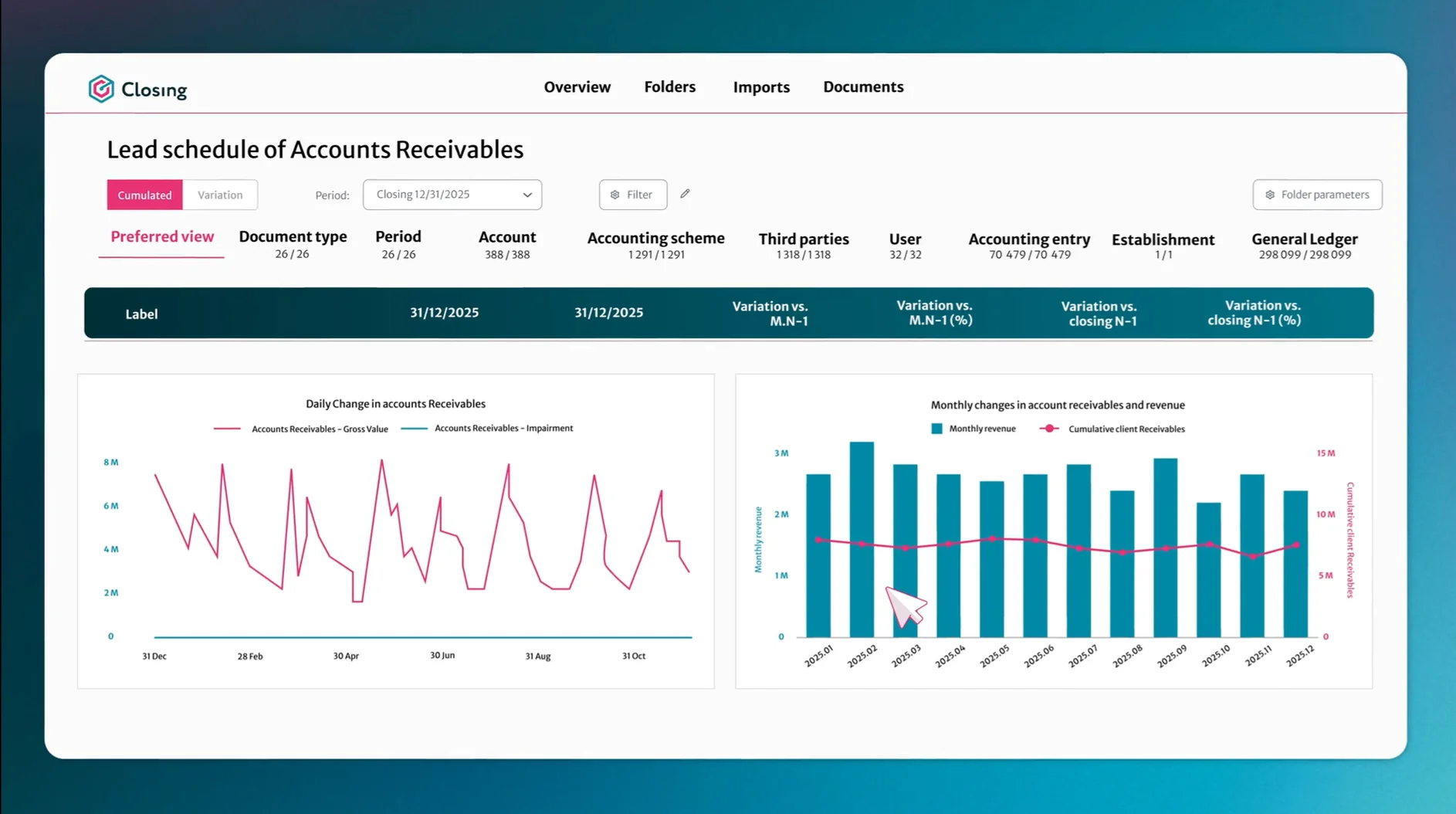
- Leverage assisted analytical reviews for effectiveness and accuracy
- Use pre-populated control schedules to strengthen your checks
- Track the ageing of unbalanced entries to identify unresolved anomalies
- Navigate the full general ledger and drill down from balances to transaction level
- Analyse entries across periods, with monthly or annual views to match your review frequency
- Get automated alerts so you can act quickly, where it matters most

Automate controls and detect anomalies
Move beyond balance justifications and detect unusual journal entries with AI-powered insights:
- Work from harmonised, analysis-ready data, regardless of source
- Instantly flag anomalies and potential errors
- Access accounting data from all your ERPs in one transparent view
- Prioritise the accounts and entries that need attention, so reviewers focus their time where it matters most

Standardised close controls & team coordination
Standardise and streamline your processes to better coordinate your teams during the closing process. With a customisable core model, you can structure the review process to fit your needs:
- Collaborate on a single platform, regardless of language, charts of accounts, or entity
- Standardise every step of the close: accounting cycles, financial statements, lead schedules, analytical reviews, account reconciliations, and anomaly analysis
- Benefit from a clear, optimised account reconciliation process that gives your teams a structured view to spot, analyse, and document variances with ease
- Implement structured work programmes to align procedures within the group
- Assign tasks, track progress, and collaborate seamlessly with integrated workflows
- Manage in real time with a consolidated timeline and full visibility across all entities, including subsidiaries

Centralised documentation & full audit trail
Reduce compliance risk by centralising every supporting document from your reviews. Everything traceable, everything in one place:
- Centralise balance justifications, supporting evidence and review comments alongside the accounting data, with a complete history of accounting reviews for full traceability
- Record review statuses and sign-offs for every account, creating a single source of evidence for each close
- Simplify access to supporting materials for all members of your team
- Provide clear, comprehensive documentation, available on demand to external auditors, and streamline the exchange process

Secure your review work & close controls
Stay aligned with regulatory and organisational changes using a solution designed to adapt and hold up over time:
- Standardise your balance sheet review processes for long-term reliability, whatever the context
- Mitigate risks from complex spreadsheets and macros, along with their manual maintenance which usually relies on a few individuals
- Support internal restructurings and major ERP or shared service centre (SSC) implementation projects with confidence

Retain and empower talent
Make your accounting function more attractive to talent by offering modern solutions that maximise productivity:
- Free employees from repetitive manual tasks so they can focus on analysis, enhance collaboration, and boost team engagement
- Make better-informed decisions with reliable, audit-ready data enriched by advanced analysis – building trust with leadership, the board, and investors
- Simplify the analytical review of the balance sheet and income statement – a critical step in the dialogue between accounting and finance leadership

A platform for control and analysis created alongside our clients, to accelerate and transform
Solutions built with the people who use them.

Guidance from people who know the domain.

A robust, fast, and secure platform built for the pace of your business.

Up and running from day one - efficiency that starts with your first click.

A solution that adapts to your reality - not the other way around.

Easily integrate your data, let Closing do the work, and leverage the results
Your Frequently Asked Questions about
Close Review, Analysis, and Sign-Off
1. What sets Closing apart from competing tools?
- A structure and content designed with our clients’ accounting teams, grounded in real closing practice
- Fast deployment, with a ready-to-use core model live within weeks
- An intuitive interface built for immediate adoption
- Full general ledger integration, with instant drill-down to individual journal entries
- Development and hosting in Europe, for security and data sovereignty
- Hands-on, responsive support tailored to your teams
2. How does Closing simplify change management for my teams?
Closing simplifies change management by offering a familiar interface and structure similar to Excel, seamlessly aligning with your existing workflows and replicating accounting cycles. Unlike other tools that enforce rigid methods and require restructuring your teams, Closing respects your established processes and governance while supporting and enhancing them for easy adoption.
3. Is Closing suited to international groups with multiple entities or ERPs?
Absolutely! Developed in collaboration with international clients, Closing is international by design to seamlessly integrate complex systems. It centralises and analyses data from all your entities, regardless of their chart of accounts, ERP systems, currencies, or languages. Currently, Closing is available in multiple languages.
4. What immediate benefits does Closing bring to accounting teams?
Closing directly addresses the common pain points encountered by accounting teams:
- Time savings: Automated and centralised analyses streamline processes
- Enhanced process security: Increased reliability of your financial close
- Better team collaboration: integrated comments make it easier for teams to work together
- Access to key information: Provides all the necessary data for fast and informed decision-making.
5. How does Closing flag unusual postings?
Each chart of accounts is mapped to a standardised group structure. Sensitive accounts, such as suspense accounts or other operating income and expenses, are then monitored so that unusual postings are flagged for review. A flag is not an error: it points reviewers to items that deserve a closer look. Suspense accounts in particular tend to grow during restructurings or ERP migrations, which makes them a useful indicator of where attention is needed.
6. Does Closing work on balances or on transaction-level data?
Both. Closing integrates full general ledger extracts, so your teams can review balances and analyse the underlying entries across several periods. The depth of historical data and the analysis frequency (monthly or annual) are configured to match your closing processes. Data is fed through a configured data exchange allowing Closing to work alongside your ERP without requiring any change to it.
7. How does Closing work alongside existing close or reconciliation tools?
Closing focuses on account review: analytical review of the balance sheet and income statement, balance justifications, lead schedules, and documentation, all in one place. Many groups already use tools for close task management or automated transaction matching, which work at transaction level. Closing works alongside them, covering the analytical review and review evidence that these tools address only partially. It gives you an overall view of the close at account and entity level, with drill-down to individual journal entries, using the same general ledger data.