Fraud and error detection software: reduce your accounting risk
With Sixthfin's granular, automated analysis of your accounting data, detect fraud and errors early, before they escalate.
Strengthen your controls, protect your processes, and turn your company's financial integrity into a lasting competitive advantage.
Detect risks, investigate errors, and strengthen your accounting
Fraud and error detection relies on a rigorous, proactive three-step approach:
-
1 Detect red flags and anomalies
-
2 Investigate in depth
-
3 Strengthen and harmonise your practices
Detect accounting risks with proactive, automated analysis
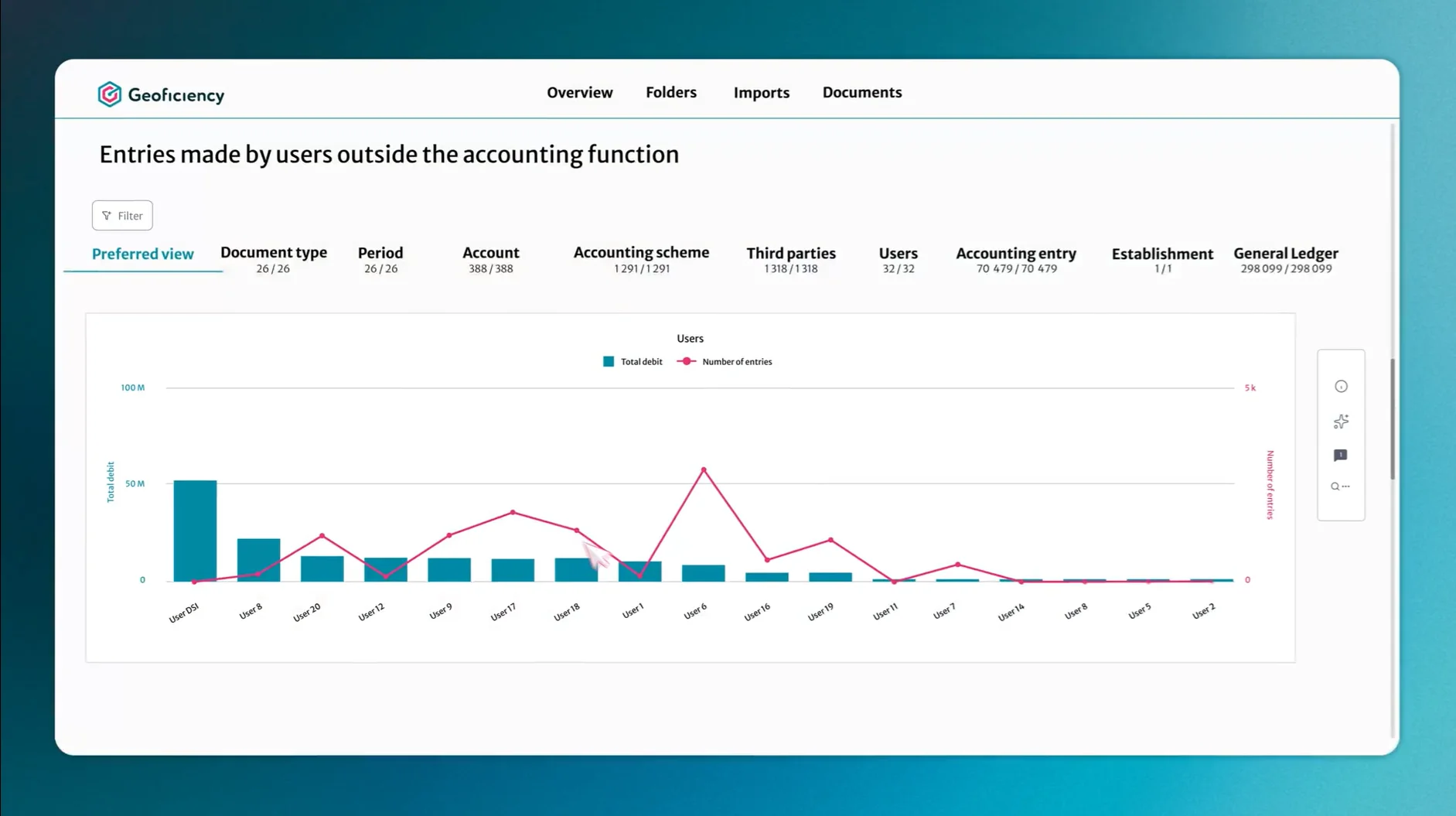
Put AI to work to spot subtle red flags and catch deviations early across all your entities, including the less critical ones:
- Draw on a library of more than 300 preconfigured controls
- Track early warning signs over time
- Assign a custom risk score to every entry and weight each analysis in line with your risk map
- Identify anomalies, duplicate invoices, duplicate payments, VAT risks, and late supplier payments
- Spot process inefficiencies and any irregular access to journal entry posting

Reduce risk through rigorous investigation
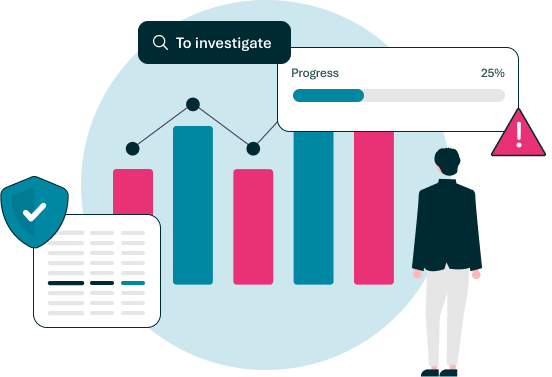
Take control of every alert. Handle each one with detailed investigation and comprehensive documentation:
- Structure your work with dedicated workflows for task assignment and sign-off
- Explore your data and drill down to individual journal entries
- Document every step of the investigation, attach supporting evidence, and keep a complete audit trail
- Understand the root causes of weaknesses in your processes and controls to prevent them from recurrin

Make your financial information more reliable and harmonise your practices
Consolidate, harmonise, and strengthen. Bring rigour to how your accounting processes are managed:
- Improve the quality of accounting controls with robust processes and accurately executed transactions
- Get a consolidated view of adherence to internal policies, whatever the size of your organisation
- Embed audit and internal control mechanisms across your operations to build a strong control culture
- Tailor your work and analysis programmes to your organisation’s specific needs, for maximum relevance

Built to detect risks and errors seamlessly.
A clear, easy-to-use platform tailored to your organisation, teams, and priorities.
Anti-corruption and anti-fraud compliance: detect fraud and corruption in your accounts
Strengthen your regulatory compliance with a dedicated module:
- Draw on a comprehensive library covering first-, second-, and third-level accounting controls
- Support compliance with anti-corruption and anti-fraud regulations, such as the UK Bribery Act, the UK Economic Crime and Corporate Transparency Act (ECCTA), and the US Foreign Corrupt Practices Act (FCPA)
- Centralise the execution, documentation, and analysis of your controls in one efficient, structured tool
Take Action:
Explore Our Solutions
Closing: the solution for streamlining and accelerating your reviews and closing processes

Geoficiency: the solution for risk detection, compliance, and operational efficiency
Your Frequently Asked Questions about
risk, error, and fraud detection
1. How can you identify major accounting risk areas?
The most significant vulnerabilities usually lie in manual period-end entries, irregular access to journal entry posting, and VAT or late supplier payment risks. Without dynamic analysis of these areas, the finance function works with only a partial view of actual risk. The key is being able to assign a custom risk level to each type of entry or transaction, in line with your own risk areas.
2. How can you make sure accounting anomalies are detected in time?
Late detection, often during an audit or after an incident, is a sign of a reactive rather than preventive set-up. An effective approach relies on regular, systematic monitoring of red flags, entry profiling, and targeted automated alerts. Without this level of granularity, fraud schemes or control workarounds can go undetected for years.
3. How can you tell real anomalies from false positives?
A control set-up that generates too many undifferentiated alerts ends up being bypassed or ignored by teams, a phenomenon known as alert fatigue. The relevance of alerts depends directly on the quality of the configuration: criticality weighted by risk type, contextual filtering, and the ability to investigate quickly and in depth to qualify each signal. The aim is to focus teams on the anomalies that really matter.
4. What should you monitor to ensure effective detection of accounting risks and errors?
Detection is only as good as the reliability and completeness of the source data. In groups with multiple ERPs, charts of accounts, or currencies, inconsistent reference data is often the first obstacle: data is not comparable, and controls cannot be applied consistently. Before automation, the priority is to harmonise accounting data and make it reliable, so that it is fit for analysis and oversight.
5. How can you detect red flags in high-risk transactions?
A proactive approach relies on analysing every transaction, profiling entries, and automatically detecting anomalies. Sampling and occasional spot checks are no longer enough once volumes become significant: the most sophisticated fraud schemes are designed precisely to stay below traditional detection thresholds.