Eliminating Excel to ERP Back-and-Forth. A Strategic Imperative for CFOs and Finance Leaders.
Rethinking the Financial Close: How CFOs Can Eliminate Excel–ERP Friction
The CFO’s New Closing Reality: Time Pressure, Fragmented Data, and Rising Expectations
There is huge pressure on the closing calendar. CFOs are expected to deliver fast, reliable, audit-ready numbers, while simultaneously managing multiple ERPs, various charts of accounts, and mixed maturity levels across subsidiaries. And yet, in many organisations, the closing process still relies on repeat extractions from the ERP, massive Excel files, complex macros that are increasingly difficult to maintain, and manual reconciliations.
As CFOs know, this model doesn’t scale. It increases the operational burden on accounting teams, exposes the group to data integrity risks, and deprives CFOs of the visibility required to steer performance. Our recent survey found that 57% of CFOs consider that financial close management in their company is not very satisfactory and. 67% say that improving the reliability of accounts is a priority.
Why Excel Is Not the Enemy, just a Poor Foundation for the Closing Period.
- Excel remains indispensable for ad-hoc analysis. But when it becomes the backbone of the closing process, it introduces structural risks:
- Hard limits on data capacity. Excel cannot handle more than ~1 million rows, making it unsuitable for large, multi-entity general ledgers generated by international groups.
- Local modifications = lack of group-wide consistency. Group-level instructions often break down when subsidiaries adapt workbooks, alter formulas, or use local versions of templates, a problem highlighted frequently by auditors.
- Accumulated technical debt in Finance. Many companies rely on legacy Excel models built years ago. These files represent a massive technical debt; they are complex, undocumented and increasingly difficult to maintain. When the person who created the macros leaves, the process becomes a “black box’. The team ends up spending more time servicing the debt than actually performing financial analysis.
- Zero audit trail. Excel cannot natively guarantee version history, control status changes, or who reviewed what and when all essential elements for audit reliability.
In short: Excel is powerful for insight, but inadequate for governance.
Beyond the obvious time wasted on extractions, the repeated movement between ERP and Excel creates four major issues for CFOs:
- Productivity loss under tight deadlines. From Day 1 to Day 5 accounting teams spend disproportionate effort preparing data instead of analysing it. Every extraction and reformatting action consumes time allocated to value-added controls.
- Lack of analytical depth. Complex analyses (N vs N-1, Year on Year, trend analysis, ageing, reconciliations) become difficult or inconsistent when manually assembled in Excel. This leads to shallow or incomplete reviews.
- Uneven quality across subsidiaries. Different ERPs, file structures, or maturity levels mean group accounting receives diverse outputs. Analyses cannot be compared from one subsidiary to another.
- Operational blind spots for CFOs. With no consolidated dashboard, group finance leaders lack visibility on which entities are late, which cycles are at risk, and where red flags are.
These structural inefficiencies impede the CFO’s ability to manage performance and ensure reliable consolidated reporting.
What CFOs Need: A Zero-Friction Access to Data
The most effective way to eliminate Excel–ERP back-and-forth is to import the general ledger once into a dedicated environment that supports:
- Unlimited capacity
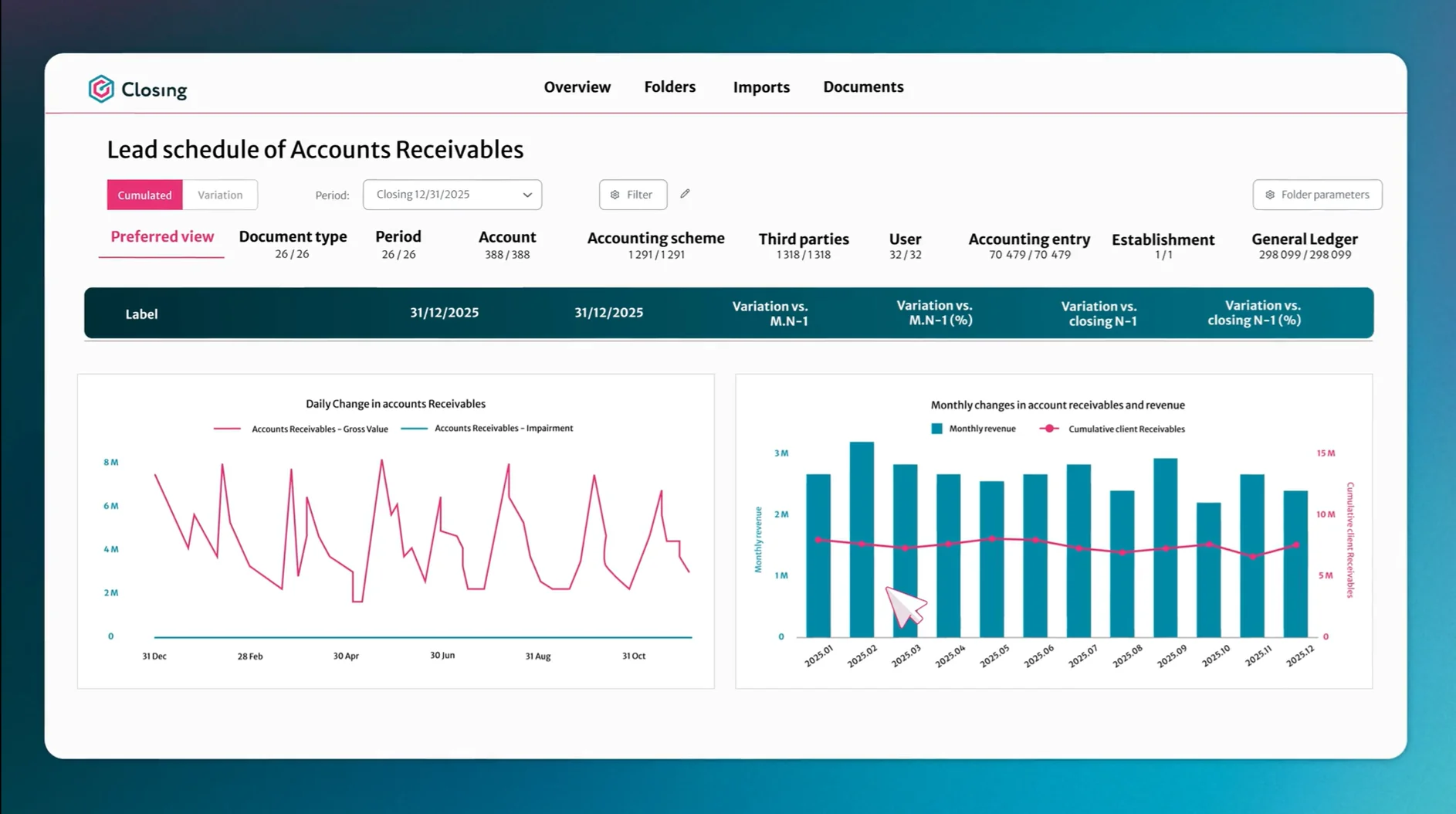
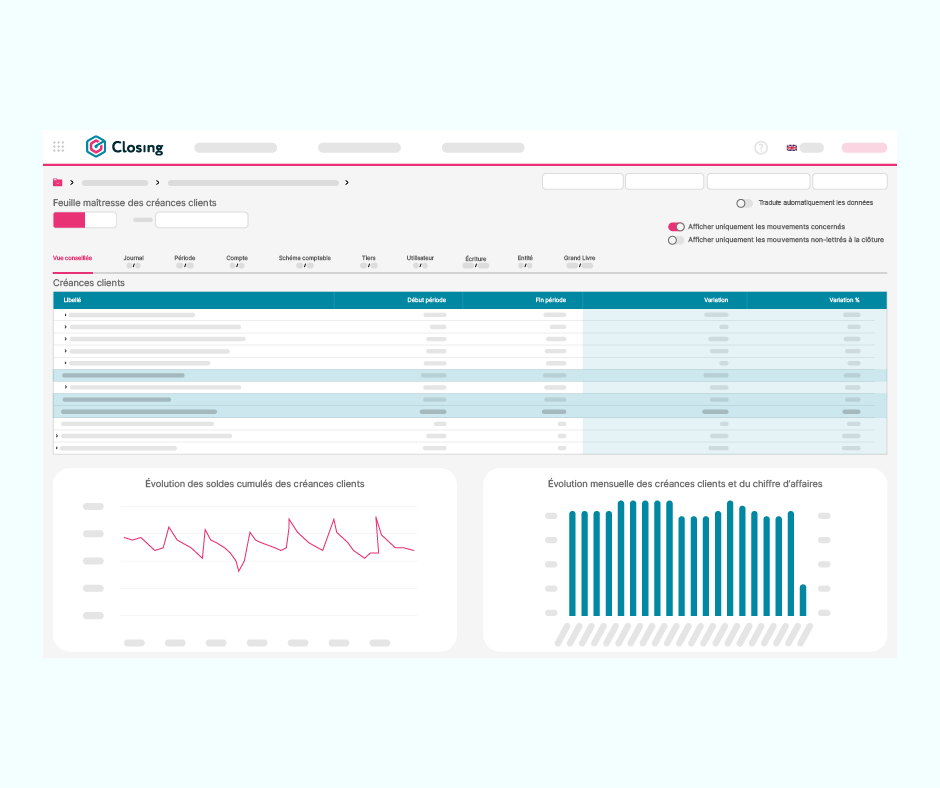
- The ability to drill-down from aggregated financial statements to transaction-level detail
- Excel-like analysis to pivot and slice data by document type, user, period, or entity, keeping the flexibility of a spreadsheet within a governed environment.
- Harmonisation of multiple charts of accounts and ERPs
- Autonomous navigation without IT intervention
This shift removes the most low value tasks from the closing process. There are no repeated extractions, no reformatting, no dependency on IT. Once the general ledger is centralised, CFOs can rely on pre-built analytical layers that remove hours of manual work. Amongst other things, the finance team is then able to produce:
- Automated comparative analysis (N, N-1, Year End N-1). With variations calculated instantly and drill-downs available on each line item.
- Ageing analysis of accounting entries. A single click reveals the ageing of receivables, payables, or any balance sheet component. This is a task that’s complicated in Excel due to the volume of data.
- Pre-populated reconciliation tables. For equity movements, provisions, accruals, or asset balances, templates come ready-made with roll-forward logic.
- Revenue and purchases reconciliation by counterparty. Crucial to ensure revenue truly comes from invoices and not overstated via cut-off entries.
- Analytics for manual journal entries. Seasonality patterns, late postings, weekend entries, or manual entries in general journals are detected automatically.
Where finance teams previously spent hours massaging files, they now spend minutes interpreting insights.
Here’s How “Zero Excel–ERP Back-and-Forth” Works in Practice
- Credit notes to be issued. A CFO can instantly see that over 60% of open items are more than 180 days old, then drill down into responsible entities or users, attach evidence, and assign remediation tasks, all within one system.
- Provisioning controls. The calculation vs booked amount appears automatically, showing misalignments that Excel-based processes often overlook.
- Multi-country comparisons. With harmonised structures, subsidiaries using SAP, Oracle, SAGE, or local ERPs can be compared directly across identical analytical frameworks.
- Auditor collaboration. Documentation is attached to accounts and entries, and auditors can access closed periods in read-only mode. This reduces audit pressure and last-minute requests.
A Closing Process Built for CFOs, Not for Files
Removing Excel–ERP back-and-forth is not about abandoning Excel. It is about putting it back in its rightful place: as a flexible analysis tool, not a critical production environment. For CFOs, the shift to a centralised general ledger, with automated analyses and a controlled closing workflow, becomes a matter of governance, efficiency, and credibility. The era of extracting, reformatting, and stitching data in Excel is behind us. The future is a unified, reliable, audit-ready closing cycle.
About the author:
Olivier Cornet, UK Country Manager
Olivier Cornet joined Sixthfin in 2024 as UK Country Manager, bringing over 20 years of B2B software expertise. While he possesses a strong background in regulatory standards, Olivier is passionate about the bigger picture: helping finance teams work smarter. He guides companies in adopting solutions that not only ensure compliance but significantly improve the efficiency of their daily financial operations.
Published on 19.06.2026